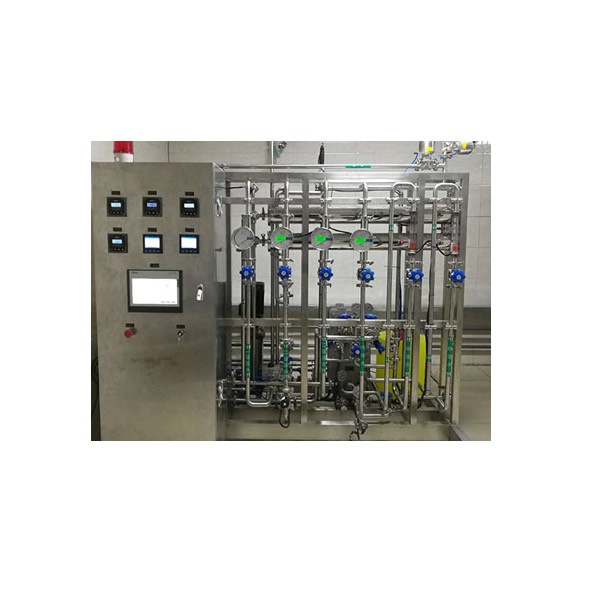
EDI Pure Water System
Product Introduction
EDI (Electrodeionization) is a mature water-treatment technology that combines two established deionization methods — electrodialysis and ion-exchange mixed bed — into a single, continuous process.
In a pure water EDI system, feed water passes through a dilute compartment filled with regenerable ion-exchange resin. Impurity ions are adsorbed by the resin to produce purified water, while the resin is continuously regenerated in place by H⁺ and OH⁻ ions generated when water splits under the DC electric field — so the resin stays active without any chemical regeneration. The released impurity ions migrate directionally under the DC field, pass through ion-selective membranes into the concentrate compartment, and are carried away by the concentrate stream.
This purification cycle proceeds uninterrupted — purify → regenerate → purify — delivering high-purity water continuously and efficiently.
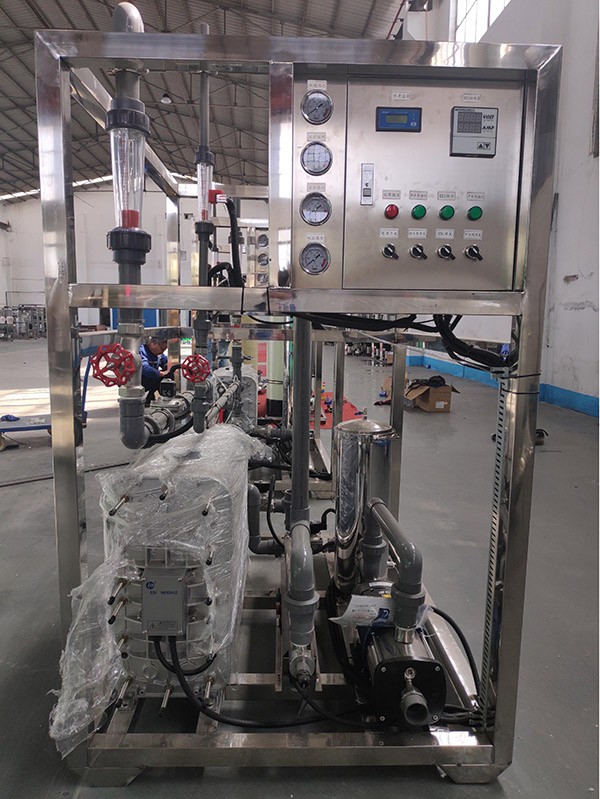
Key Features
High and stable product-water quality.
Continuous, uninterrupted production — no shutdown required for regeneration.
Modular construction with fully automatic control.
No acid or alkali regeneration; zero acidic or alkaline wastewater discharge.
No regeneration equipment and no storage or transport of regeneration chemicals.
Compact, space-saving footprint.
Low operating and maintenance cost.
Simple to operate, with low labor intensity.
Technical Specifications
Water Quality | Process Flow | Material | Application Industry |
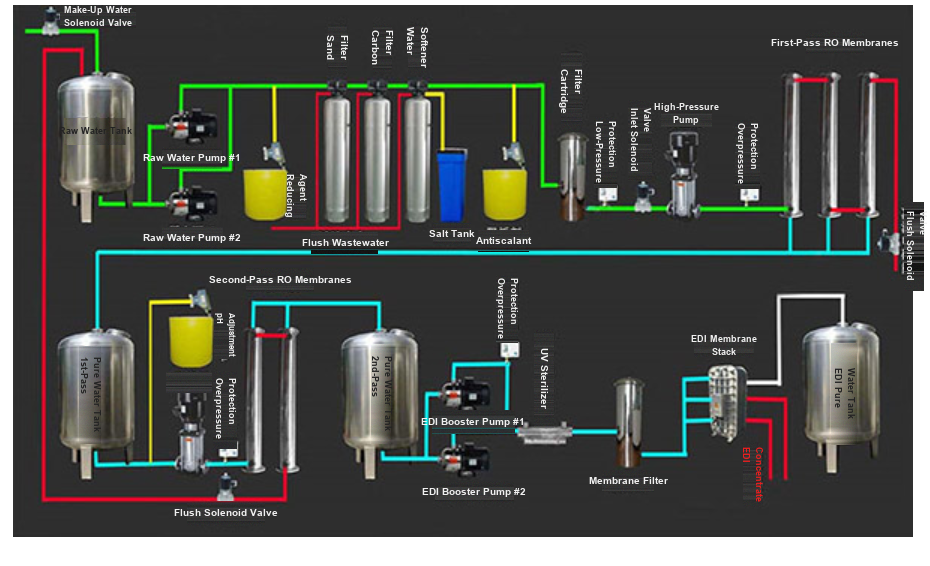
Conductivity ≤ 10 μS/cm | Raw water → raw-water tank → booster pump → mechanical filter → activated-carbon filter → water softener → precision filter → primary high-pressure pump → primary RO → pure-water tank | Stainless steel | Potable purified water / Food / Beverage / Chemical / Aquaculture / Agriculture |
Conductivity ≤ 2 μS/cm | Primary RO → mixed bed → pure-water tank | Stainless steel | Chemical / Electronics / Electroplating / Hospitals / Batteries |
Conductivity ≤ 0.5 μS/cm | Primary RO → EDI → pure-water tank | Stainless steel | Electronics / Semiconductor / Fine chemicals |
Conductivity ≤ 0.2 μS/cm | Secondary RO → mixed bed → pure-water tank | Stainless steel | Electronics / Semiconductor / Pharmaceutical / Fine chemicals |
Conductivity ≤ 0.1 μS/cm | Secondary RO → EDI → pure-water tank | Stainless steel | Pharmaceutical / Biotechnology / Fine chemicals / Microelectronics |
Conductivity ≤ 0.055 μS/cm | Primary RO + mixed bed + secondary polishing mixed bed / Secondary RO + EDI + polishing mixed bed → pure-water tank | Stainless steel | High-purity analysis / LCD / Chips / High-end pharmaceuticals |
Feed Water Requirements
Parameter | Requirement |
Feed water | RO permeate, conductivity < 20 μS/cm |
pH | 7.5 – 9 |
Temperature | 15 – 35 °C |
Inlet pressure (DIN) | 0.15 – 0.4 MPa |
Inlet hardness | < 1.0 ppm (as CaCO₃), recommended < 0.5 ppm |
Inlet organics (TOC) | < 0.5 ppm |
Inlet silica (SiO₂) | < 0.5 ppm |
Total CO₂ | < 3 ppm |
Inlet particle size | < 1 μm |
Process Flow
The EDI module is normally fed by RO permeate. Inside the module, a DC electric field drives continuous ion removal and resin regeneration, producing stable high-purity water without chemical regeneration.
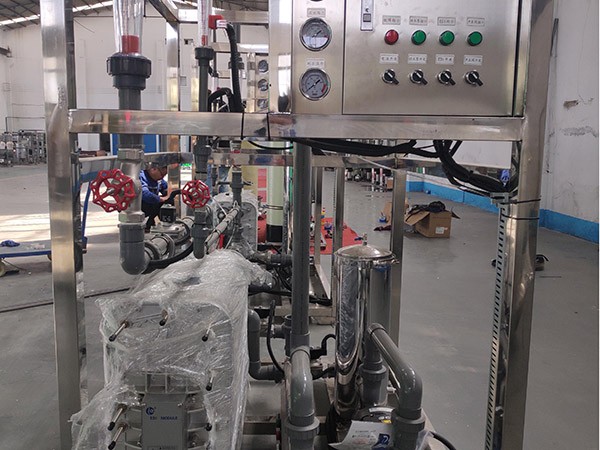
Product Details
Applications
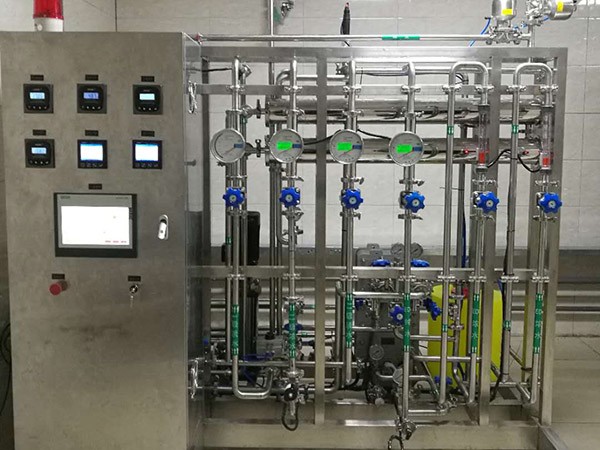
EDI pure water systems are widely used in potable and beverage water production, food and fine-chemical processing, electroplating and battery manufacturing, electronics, semiconductor and microelectronics production, pharmaceutical and biotechnology, and high-purity analytical applications such as LCD and chip fabrication and high-end pharmaceutical manufacturing.