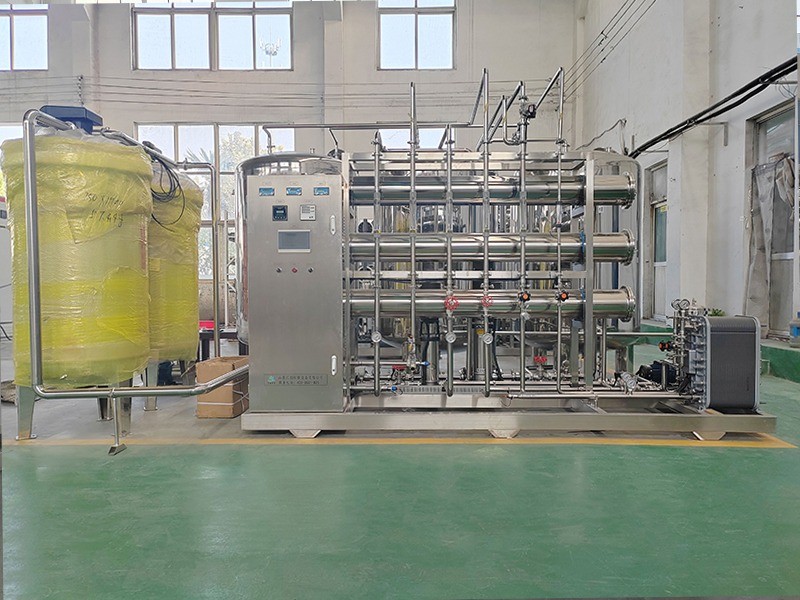
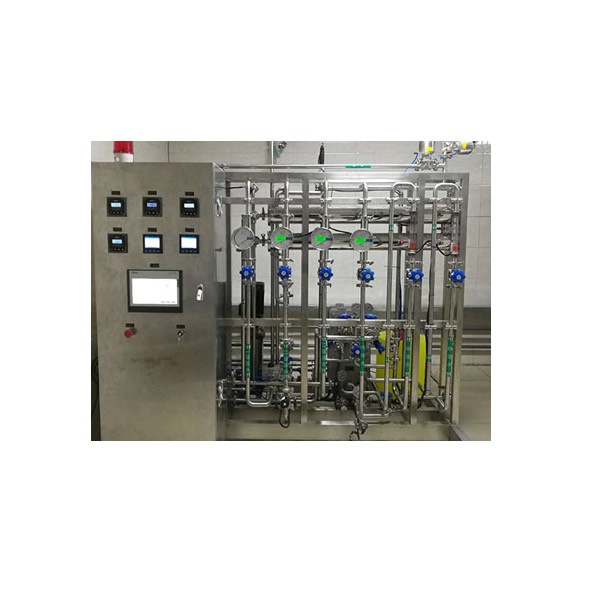
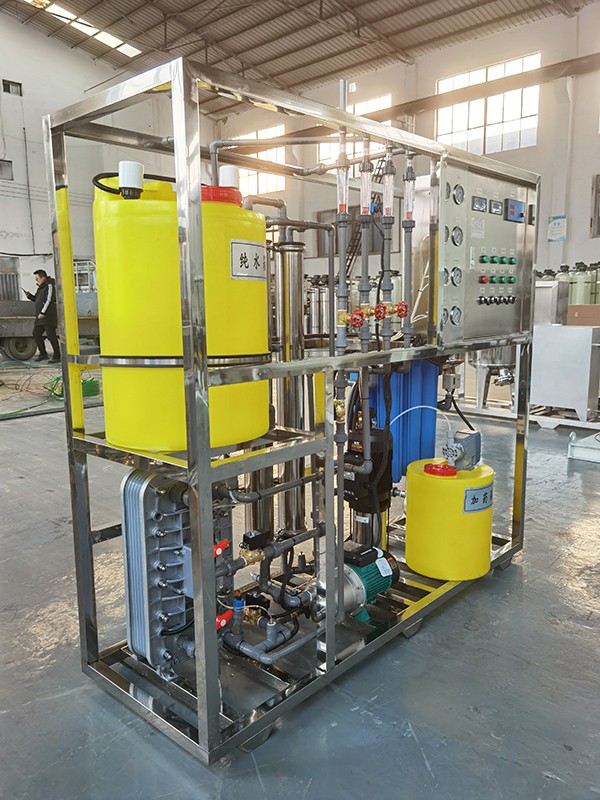
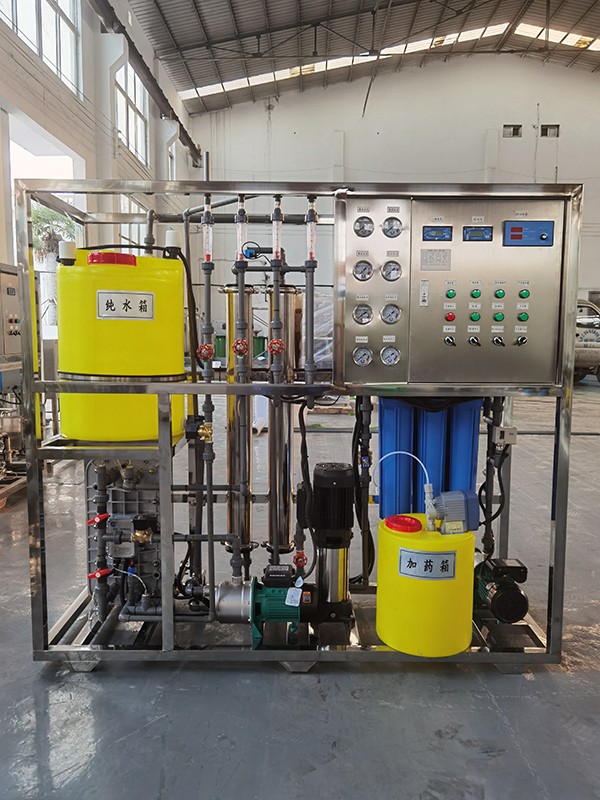
0.5 T/H Reverse Osmosis + EDI Ultrapure Water System
Product Introduction
The system treatment train is: pre-treatment → reverse osmosis → EDI.
In a single-stage RO + EDI configuration the EDI stack has a comparatively short service life. The reason is that an EDI unit can remove salts, but only a very small salt load — it cannot carry a larger desalination duty. Therefore, when EDI is used as the final desalination stage, a double-stage reverse osmosis system is recommended upstream of it.
EDI (continuous electrodeionization) produces pure water without acid or alkali regeneration and is one of the more advanced desalination technologies in use today. It offers the following advantages:
- Continuous operation with stable product-water quality
- Ultrapure water recovery of up to 70%
- No acid or alkali storage, dilution or transport facilities required
- No acid or alkali regeneration
- No regeneration wastewater, so no wastewater treatment facility is needed
- Saves the backwash and cleaning water used by the reverse osmosis system
- Reduces building footprint and lowers maintenance cost
- Operators are never exposed to acid or alkali
- Simple installation and low installation cost
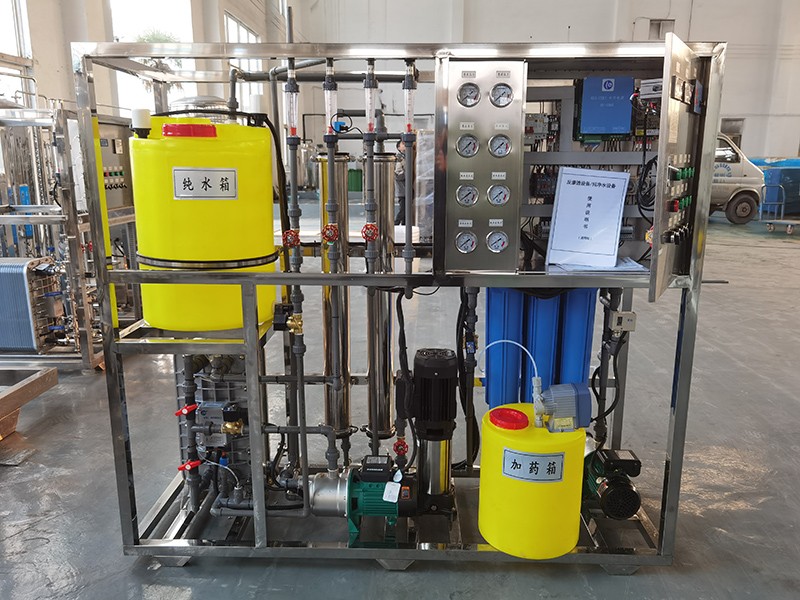
How EDI Works
EDI combines two established deionization methods — electrodialysis and ion-exchange mixed bed — into a single continuous process. Feed water passes through a dilute compartment filled with regenerable ion-exchange resin. Impurity ions are adsorbed by the resin to produce purified water, while the resin is continuously regenerated in place by the H⁺ and OH⁻ ions generated when water splits under the DC electric field, so the resin stays active without chemical regeneration. The released impurity ions migrate under the DC field, pass through ion-selective membranes into the concentrate compartment and are carried away by the concentrate stream. The cycle — purify → regenerate → purify — runs uninterrupted, delivering high-purity water continuously.
Key Features
- High and stable product-water quality, produced continuously.
- Continuous, uninterrupted production — no shutdown for regeneration.
- Modular construction with fully automatic control.
- No acid or alkali regeneration and zero acidic or alkaline wastewater discharge.
- No regeneration equipment, and no storage or transport of regeneration chemicals.
- Compact, space-saving footprint with reduced building cost.
- Low operating and maintenance cost.
- Simple to operate, with low labour intensity and no operator contact with acid or alkali.
Technical Specifications
Parameter | Specification |
Model | 0.5T Reverse Osmosis + EDI |
Product Water Flow | ≥ 0.5 m³/h |
Ultrapure Water Recovery | ≥ 70% |
Process | Pre-treatment → reverse osmosis → EDI |
RO Configuration | Single-stage RO + EDI (double-stage RO recommended upstream for longer EDI service life) |
Feed Water | Municipal tap water meeting the drinking-water standard |
Feed Water Temperature | 5 – 45 °C |
Pre-treatment | Sand filter, carbon filter, water softener, security filter |
Regeneration | None required (continuous electric regeneration in the EDI stack) |
Control Mode | Fully automatic, with on-line monitoring instruments |
Process Flow
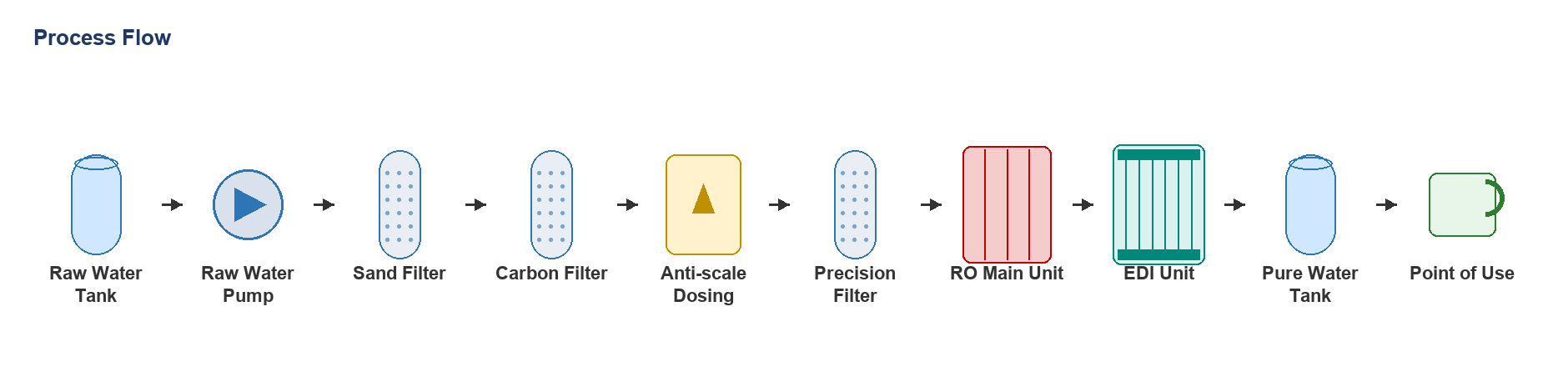
Raw water is drawn from the raw-water tank by the raw-water pump and passes through the sand filter, the carbon filter and the water softener; anti-scale chemicals are dosed to protect the membranes and a precision (security) filter provides final protection. The filtered water is purified by the RO main unit, and the RO permeate is then polished in the EDI unit, where dissolved salts are removed continuously by combined electrodialysis and ion-exchange action. The ultrapure water is stored in the pure-water tank and delivered to the point of use.
Product Details
Applications
- Ultrapure water for the electronics and semiconductor industry
- Purified water for pharmaceutical production, medical preparations and laboratory use
- Boiler make-up water for power plants and industrial boilers
- Product-formulation water in the beverage, food and cosmetics industries
- Highly purified process water for electroplating and surface treatment