2 T/H Ultrapure Water System (RO + EDI)
Product Introduction
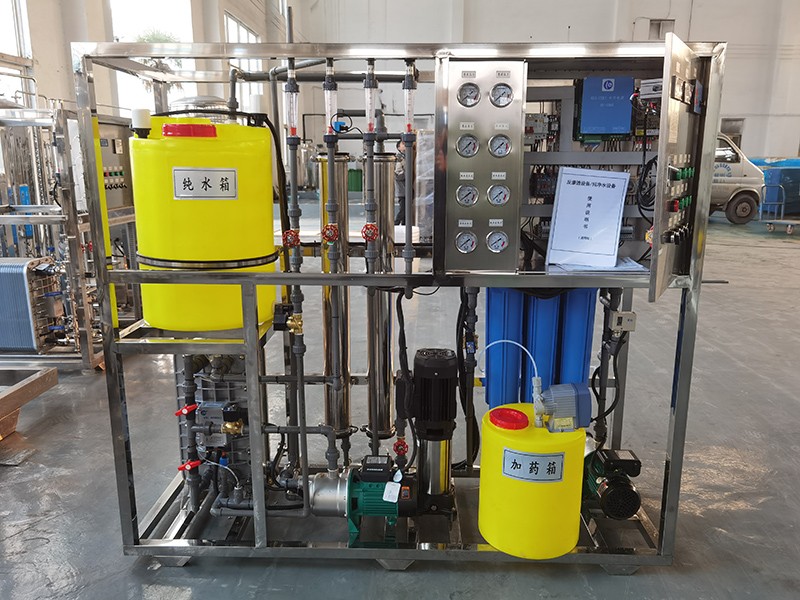
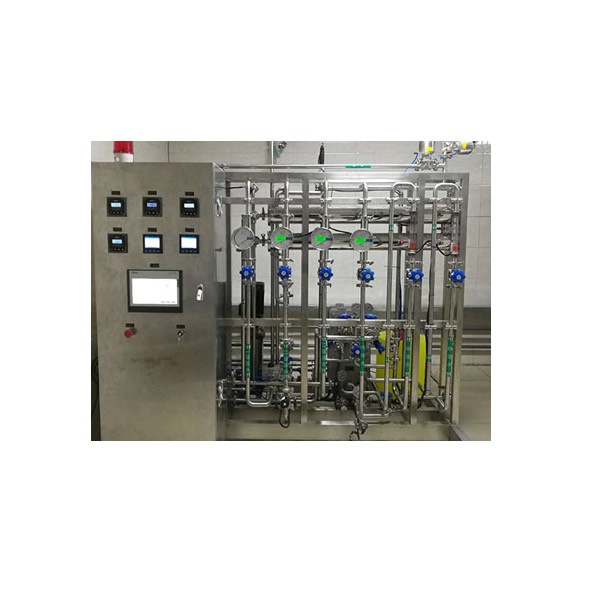
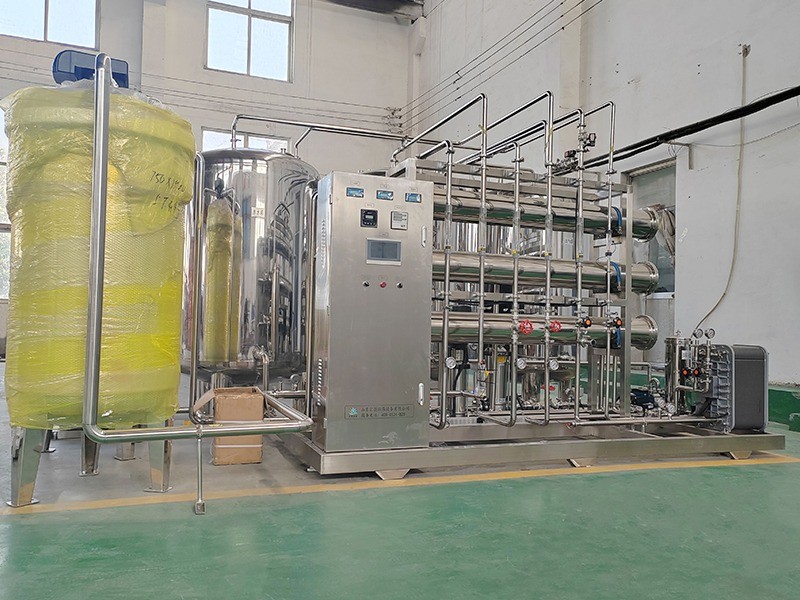
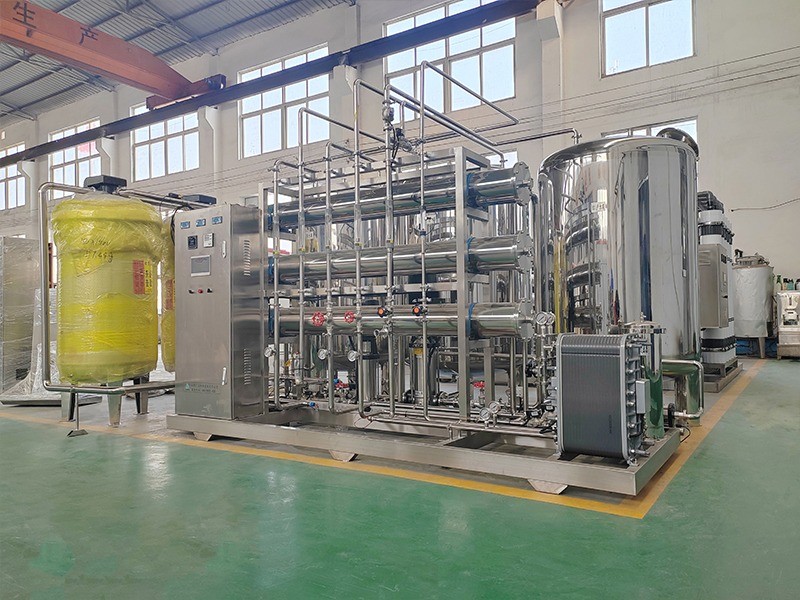
The 2 T/H ultrapure water system combines reverse osmosis (RO) and continuous electrodeionization (EDI) to produce high-purity water from municipal tap water. The process train is: pre-treatment → reverse osmosis → EDI.
Pre-treatment
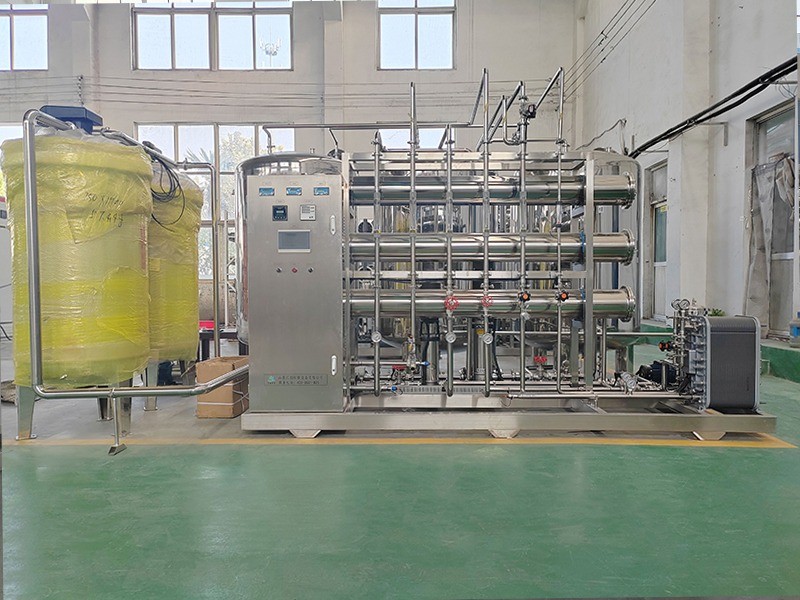
Pre-treatment conditions the raw water so that it meets the feed requirements of the RO unit, reducing and delaying membrane fouling and extending membrane life. It removes micro-organisms, bacteria, colloids, organic matter, heavy-metal ions, solid particles and free chlorine. The pre-treatment section consists of a sand filter, a carbon filter, an anti-scale dosing unit and a security filter.
- Sand filter — removes mud, sand, impurities and suspended solids from the water and lowers the SDI (silt density index) of the raw water.
- Carbon filter — has a dual function: adsorption and filtration. It removes chemical organic matter, heavy metals, colour, odour and residual chlorine from the water and improves water quality.
- Anti-scale dosing unit — doses a suitable amount (3–5 ppm) of anti-scale agent to inhibit the scaling tendency of calcium, magnesium, carbonate and sulphate ions, helping the membrane remove hardness ions and preventing membrane scaling.
- Security filter — a 5 µm PPF cartridge that intercepts particles larger than 5 µm and extends membrane life.
Reverse Osmosis Unit
The RO membrane has a separation pore size of 10⁻⁶–10⁻⁷ cm and removes organic matter (such as trihalomethane intermediates, colloids, suspended solids, micro-organisms, bacteria, algae and moulds), pyrogens and viruses from the water. After the three stages of pre-treatment, the water is deeply separated by the RO membrane main unit: the fraction beneficial to health passes through while the rest is discharged, giving a desalination rate of 98%. The pure water produced is stored in the pure-water tank. Membrane filtration may be arranged as single-stage or double-stage reverse osmosis.
EDI Unit
Continuous electrodeionization (EDI) uses mixed ion-exchange resin packed in the dilute compartment to adsorb the cations and anions in the feed water. Under a DC voltage these adsorbed ions migrate laterally and pass through the cation- and anion-exchange membranes into the concentrate compartment, where they are removed. As the water travels forward and ions are continuously removed, the conductivity of the solution falls; under the DC voltage the water dissociates to generate enough H⁺ and OH⁻ ions to maintain the system current. Besides migrating laterally, these H⁺ and OH⁻ ions regenerate the ion-loaded resin in place, achieving continuous deep desalination.
Two conditions must be met: the ion content of the feed water must not be too high, and the applied DC voltage must reach a certain value. EDI technology can replace conventional ion-exchange (DI) equipment and produces ultrapure water with a resistivity of up to 10–18 MΩ·cm.
Key Features
- Combined RO + EDI process producing ultrapure water with resistivity up to 10–18 MΩ·cm.
- Continuous operation with stable product-water quality.
- No acid or alkali regeneration and no regeneration wastewater.
- Complete pre-treatment (sand filter, carbon filter, anti-scale dosing and 5 µm security filter) protects the RO membranes.
- 98% desalination rate; single-stage or double-stage RO as required.
- Compact, fully automatic system with on-line monitoring instruments.
Technical Specifications
Parameter | Specification |
Model | 2T RO + EDI |
Product Water Flow | ≥ 2 m³/h |
Product Water Resistivity | Up to 10 – 18 MΩ·cm |
Desalination Rate | 98% |
Process | Pre-treatment → reverse osmosis → EDI |
RO Configuration | Single-stage or double-stage reverse osmosis |
Pre-treatment | Sand filter, carbon filter, anti-scale dosing unit, 5 µm security filter |
Anti-scale Dosage | 3 – 5 ppm |
Feed Water | Municipal tap water meeting the drinking-water standard |
Process Flow
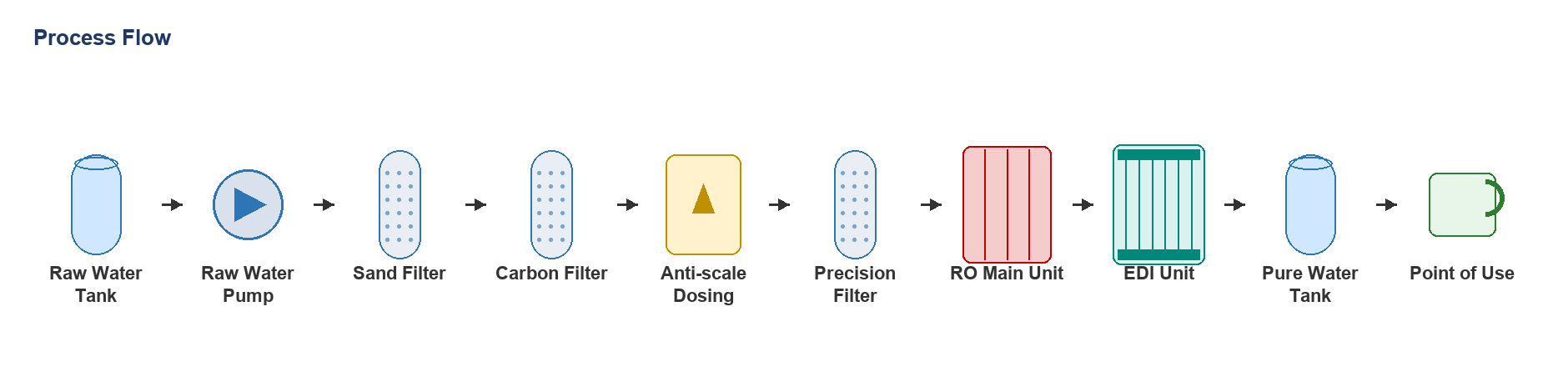
Raw water is pre-treated by the sand filter and carbon filter, dosed with 3–5 ppm of anti-scale agent and finally protected by a 5 µm security filter. The filtered water is deeply desalinated in the RO main unit with a 98% desalination rate and stored in the pure-water tank; it is then polished in the EDI unit, where dissolved salts are removed continuously, to give ultrapure water with a resistivity of up to 10–18 MΩ·cm at the point of use.
Product Details
Applications
- Ultrapure water for the electronics and semiconductor industry
- Purified water for pharmaceutical production, medical preparations and laboratory use
- Boiler make-up water for power plants and industrial boilers
- Product-formulation water in the beverage, food and cosmetics industries
- Highly purified process water for electroplating and surface treatment